Educational
Benefits of Glass Railings for Vancouver's Unique Climate
Published:
Last updated:
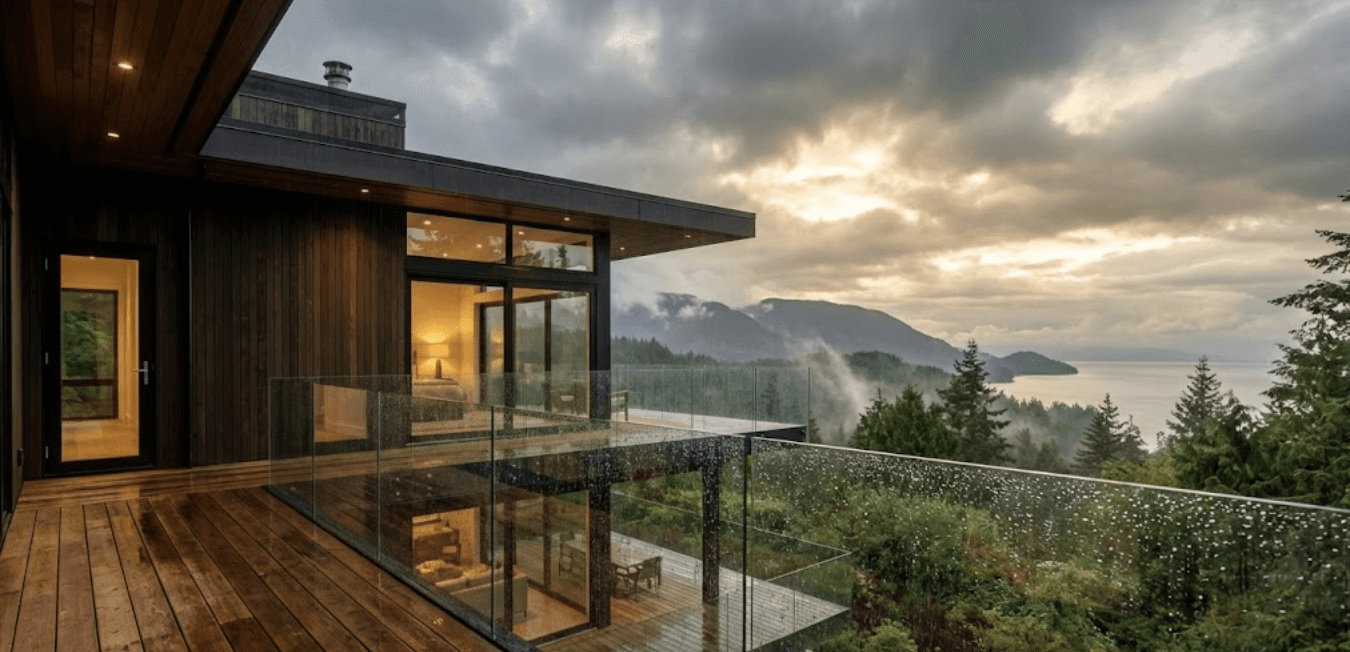
Vancouver homeowners face a unique challenge. They must protect outdoor spaces from 169+ rainy days per year while preserving mountain and ocean views that make properties valuable.
Glass railings solve this problem better than any alternative. They resist rot, corrosion, and degradation in wet, humid, salt-air conditions while requiring minimal maintenance.
This guide explains exactly why frameless glass railings and semi-frameless systems outperform wood and metal in Vancouver's demanding climate. For broader context, see our complete guide to glass railings.
Vancouver's Climate Challenges for Outdoor Railings
Before choosing a railing material, understand what Vancouver's weather does to outdoor structures. The region presents a combination of moisture, humidity, and salt exposure that accelerates material breakdown.
Rain and Moisture Exposure
Vancouver is Canada's third most rainy city, with 169 rainy days per year (Wikipedia, 2024). That means outdoor railings spend nearly half the year wet.
Annual rainfall reaches approximately 1,189mm at the airport. In North Vancouver near the mountains, that figure doubles to 2,477mm (Wikipedia, 2024).
November is the wettest month, dumping 344mm of precipitation across 20 rainy days (Weather-and-Climate, 2024). This prolonged surface wetness accelerates decay in porous materials like wood.
Humidity and Seasonal Patterns
Winter humidity in Vancouver regularly exceeds 85%, with January averaging 85.75% relative humidity (Climate-Data, 2024). High humidity keeps surfaces damp even between rain events.
Unlike colder Canadian cities, Vancouver rarely experiences hard freezes. Mild temperatures allow decay processes to continue year-round without the seasonal pause that kills fungi in harsher climates.
The region does experience freeze-thaw cycles from November through March. These temperature swings stress mounting hardware and can expand microscopic cracks in susceptible materials.
Salt Air and Coastal Exposure
Properties across Metro Vancouver face varying degrees of salt air exposure. Waterfront communities like West Vancouver, White Rock, and Richmond experience the highest concentrations.
Research shows the highest coastal corrosion rates occur within 400 to 600 metres of the shoreline, rising exponentially within the closest 50 to 200 metres (IMOA, 2024). Many Fraser Valley properties along rivers and inlets also face elevated exposure.
Vancouver's Climate by the Numbers
Climate Factor
Measurement
Impact on Railings
Rainy days per year
169 days
Constant moisture exposure
Annual rainfall (airport)
1,189mm
Surface wetness year-round
Annual rainfall (North Van)
2,477mm
Double exposure near mountains
Winter humidity
85%+
Accelerated corrosion and rot
Wettest month
November (344mm)
Peak stress period
Corrosion zone
Within 600m of shore
5-10x faster metal degradation
Why Wood Railings Fail in Vancouver's Climate
Wood remains popular for its natural appearance and lower upfront cost. However, Vancouver's moisture levels create conditions where wood struggles to survive.
The Wood Rot Reality
Wood rot is endemic to the Pacific Northwest due to high rainfall and moisture levels (Groundworks, 2025). The fungi that cause decay need only 28 to 30 percent moisture content in wood to begin growing.
Vancouver's mild temperatures make the problem worse. In regions with harsh winters, freezing temperatures kill decay fungi seasonally. Here, mild conditions allow rot to progress year-round without interruption (Groundworks, 2025).
Pressure-treated wood offers some protection. However, even treated lumber typically lasts only 10 to 15 years in wet climates and requires annual maintenance (EVODEK, 2024).
Hidden Maintenance Costs
The true cost of wood railings extends far beyond the purchase price:
Maintenance Item | Frequency | Estimated Cost |
|---|---|---|
Staining and sealing | Annual | $550-$1,250 per application |
Fastener replacement | Every 2-3 years | $100-$300 |
Board repairs | As needed | $200-$500 per section |
Full replacement | Every 10-15 years | $1,500+ |
Over a 25-year period, maintenance costs often exceed the original installation. Total cost of ownership far surpasses initial savings compared to more durable materials.
Why Metal Railings Corrode in Coastal BC
Standard metal railings face their own challenges in Vancouver's marine environment. Salt air and humidity combine to accelerate corrosion beyond what manufacturers anticipate for inland installations.
Salt Air Accelerates Corrosion
Metal structures in coastal environments can corrode five to ten times faster than those located inland (University of Florida research). This dramatic difference catches many homeowners by surprise.
Research published in Nature journal found that corrosion rates increase significantly when relative humidity exceeds 70 percent (Nature, 2023). Vancouver's winter humidity averaging 85 percent far exceeds this threshold for months at a time.
Even powder-coated aluminum, often marketed as corrosion-resistant, requires marine-grade treatment to withstand Vancouver's conditions. Standard coatings may fail prematurely near the waterfront.
The Sheltering Problem
Surprisingly, balcony railings and exterior glass railings under overhangs may corrode faster than exposed ones. Research shows sheltered areas accumulate more salt because rain cannot rinse deposits away (Marine Construction Magazine, 2023).
Covered decks and protected balconies require extra attention to hardware selection and maintenance schedules.
How Glass Railings Solve Vancouver's Climate Challenges
Glass railings address each of Vancouver's climate challenges through inherent material properties. They do not absorb moisture, cannot rot, and resist corrosion entirely.
Climate Challenge vs. Glass Solution
Vancouver Challenge | Wood Response | Metal Response | Glass Response |
|---|---|---|---|
169 rainy days | Absorbs water, rots | Surface corrosion | Rain sheets off, zero absorption |
85%+ humidity | Swells, warps, decays | Accelerated corrosion | No effect whatsoever |
Salt air exposure | N/A (rots regardless) | 5-10x faster corrosion | Completely immune |
Freeze-thaw cycles | Cracks, splits | Hardware stress | Engineered for thermal stress |
Maintenance needs | Annual staining/sealing | Regular treatment | Occasional rinse |
Rain Resistance: Zero Absorption
Glass is completely non-porous. Rain sheets off the surface without any absorption into the material.
This fundamental property eliminates rot, mould, and swelling. Deck railings made from glass maintain structural integrity regardless of how much moisture they encounter.
Where wood absorbs water and begins degrading immediately, glass remains unchanged after decades of exposure. There is no annual race to seal the surface before winter rains arrive.
Humidity Performance: No Degradation
Unlike wood, glass does not absorb ambient moisture from humid air. Even when Vancouver's humidity climbs above 85 percent for weeks at a time, glass panels remain stable.
This means no seasonal swelling, warping, or contraction. Outdoor railings maintain consistent gaps and alignments year-round without adjustment.
The mounting hardware requires proper material selection for humid conditions. Quality installations use marine-grade aluminum and stainless steel that matches the glass panels' durability.
Salt Air Immunity: Corrosion-Free Glass
Glass is completely immune to chloride corrosion. Salt air that attacks metal and accelerates wood decay has no effect on glass panels.
For waterfront properties in West Vancouver, White Rock, and Richmond, this immunity provides peace of mind. The 5-10x corrosion acceleration that affects metal simply does not apply to glass.
Quality aluminum posts with marine-grade powder coatings resist salt exposure effectively. For properties directly on the water, 316 stainless steel hardware provides maximum protection.
Freeze-Thaw Durability
The 12mm glass used in quality railing systems handles thermal stress from Vancouver's freeze-thaw cycles without issue. Proper installation accommodates minor expansion and contraction in mounting hardware.
The glass itself remains stable across the temperature range Vancouver experiences throughout the year.
Extended Outdoor Season: The Wind Protection Advantage
Beyond durability, glass railings offer a practical benefit competitors often overlook. Solid glass panels create effective windbreaks that extend comfortable outdoor use.
Traditional picket railings and cable systems let wind whip through freely. On breezy days, this makes patio railings and deck spaces uncomfortable even when temperatures are pleasant.
Glass panels block wind while maintaining views. This extends the usable outdoor season into spring and fall months when wind chill would otherwise drive people inside.
The benefit is particularly valuable for waterfront properties with consistent onshore winds. Instead of abandoning the deck on breezy afternoons, homeowners can enjoy protected outdoor space. This is also where glass clearly outperforms cable railings on exposed BC decks - cable allows wind through, while glass blocks it entirely.
Safety and BC Building Code Compliance
Glass railings meet rigorous safety standards while satisfying all BC Building Code requirements. Proper installation ensures both structural safety and regulatory compliance.
BC Building Code Requirements at a Glance
Requirement | Specification | Notes |
|---|---|---|
Guards required | Drop exceeds 600mm (24") | Measured from walking surface |
Minimum height (under 1.8m drop) | 914mm (36") | Standard residential decks |
Minimum height (over 1.8m drop) | 1,070mm (42") | Elevated decks and balconies |
Glass standards | CAN/CGSB-12.1-M90 | Safety-rated glazing required |
Frameless systems | Engineer-sealed drawings | Required for topless glass guards |
Safety Glass Standards
The 12mm glass used in Tenmar railing systems is engineered to meet BC Building Code guard requirements, including CAN/CGSB-12.1-M90 safety glazing standards. Panels are rated for the impact and load forces expected in residential guard applications.
In the rare case of breakage, the glass is engineered to fracture in a controlled way that reduces injury risk compared to open picket railings or sharp-edged alternatives.
Working with experienced installers like Tenmar ensures your glass railings meet all code requirements. See our guide to professional railing installation for more details.
Ready to Discuss Your Project?
Tenmar team handles every measurement and installation. Contact Tenmar for a free consultation, or call (604) 819-9896 to discuss your deck, balcony, or patio project.
Low Maintenance in a High-Moisture Climate
Glass railings require far less ongoing care than wood or metal alternatives. This matters significantly in Vancouver's demanding climate where maintenance windows are limited.
Maintenance Comparison Over 25 Years
Task | Wood Railings | Metal Railings | Glass Railings |
|---|---|---|---|
Staining/sealing | 25 applications | N/A | None |
Rust treatment | N/A | 10-15 applications | None |
Board replacement | 2-3 full replacements | N/A | None |
Hardware replacement | Multiple times | Multiple times | Rare |
Cleaning | Quarterly + pressure wash | Monthly | Monthly rinse |
Total time investment | 100+ hours | 50+ hours | 10-15 hours |
Simple Cleaning Protocol
Maintaining glass railings in coastal BC involves straightforward steps:
Monthly: Rinse with fresh water to remove salt and debris
Quarterly: Clean with mild dish soap or diluted white vinegar
Annually: Inspect hardware for signs of wear or corrosion
Avoid high-pressure washers that can damage sealants. A standard garden hose provides sufficient rinsing for routine maintenance.
For detailed seasonal guidance, see our complete guide on how to clean and maintain glass railings for coastal BC.
No Refinishing Required
Glass eliminates the refinishing cycle that consumes time and money with wood railings:
No staining or sealing required at any interval
No rust treatment or repainting like metal railings need
No replacement of rotted sections as with wood
Glass maintains its clarity and structural integrity for decades with only basic cleaning. The time savings alone justify the investment for many homeowners.
Long-Term Value and Property Investment
Glass railings cost more upfront than wood alternatives. However, the long-term financial picture often favours glass when maintenance and replacement costs enter the calculation.
Material Lifespan Comparison
Material | Expected Lifespan (BC Climate) | Maintenance Required | Replacement Cycles (25 years) |
|---|---|---|---|
Pressure-treated wood | 10-15 years | Annual | 2-3 replacements |
Cedar wood | 15-20 years | Annual | 1-2 replacements |
Standard aluminum | 15-20 years | Regular | 1-2 replacements |
Marine-grade aluminum | 25-30 years | Minimal | None expected |
Glass panels | 25-30+ years | Minimal | None expected |
Source: (HomeGuide, 2023), (EVODEK, 2024)
Property Value Benefits
Modern glass railings appeal to Vancouver buyers seeking contemporary aesthetics. The clean lines complement West Coast architectural styles prevalent throughout the region.
Curb appeal improvements can increase home value by seven percent or more in competitive markets. Glass railings that preserve views maintain property premiums in scenic areas where sightlines drive pricing.
Browse our gallery to see completed installations across Metro Vancouver and the Fraser Valley.
Total Cost of Ownership: Glass vs. Wood (50 Linear Feet Over 25 Years)
Cost Category
Wood Railing
Glass Railing
Initial installation
~$1,500
~$15,000-20,000
Annual maintenance (25 yrs)
$5,000-10,000
Minimal (cleaning supplies)
Replacement at year 12
~$1,500
None
Replacement at year 24
~$1,500
None
Estimated 25-year total
$9,500-14,500
$15,000-20,000
The cost gap narrows considerably when factoring maintenance time, replacement hassle, and the value of unobstructed views throughout the system's life.
Overcoming Common Myths and Concerns
Glare: Modern low-iron and anti-reflective coatings minimize glare from direct sunlight or reflections off the water.
Privacy: Frosted or tinted glass provides seclusion without sacrificing brightness.
Safety: 12mm safety glass and secure anchoring meet or exceed BC safety standards.
Maintenance: Hydrophobic coatings and stainless hardware limit corrosion and staining, even in coastal areas.
Choosing the Right Glass Railing System
Two main glass railing configurations suit Vancouver properties. The right choice depends on your priorities for views, budget, and architectural style.
System Comparison
Feature | Frameless Glass | Semi-Frameless Glass |
|---|---|---|
View preservation | Maximum (no posts) | Excellent (minimal posts) |
Price point | Higher | More accessible |
Best applications | Waterfront, mountain views | All residential |
BC Code compliance | Engineer-sealed drawings required | Standard compliance path |
Installation complexity | Higher | Moderate |
Post spacing | N/A | Maximum 42 inches |
Frameless Systems
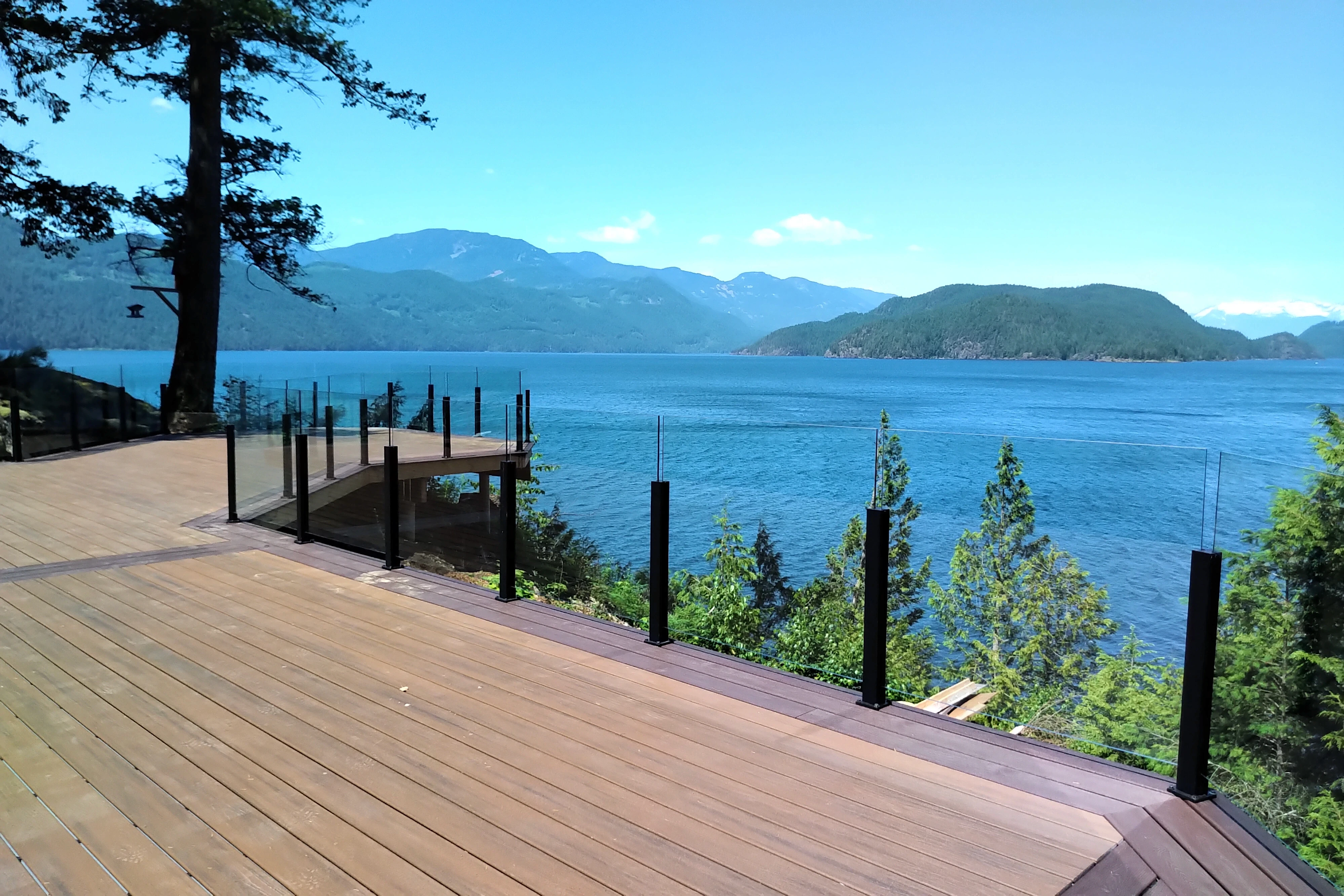
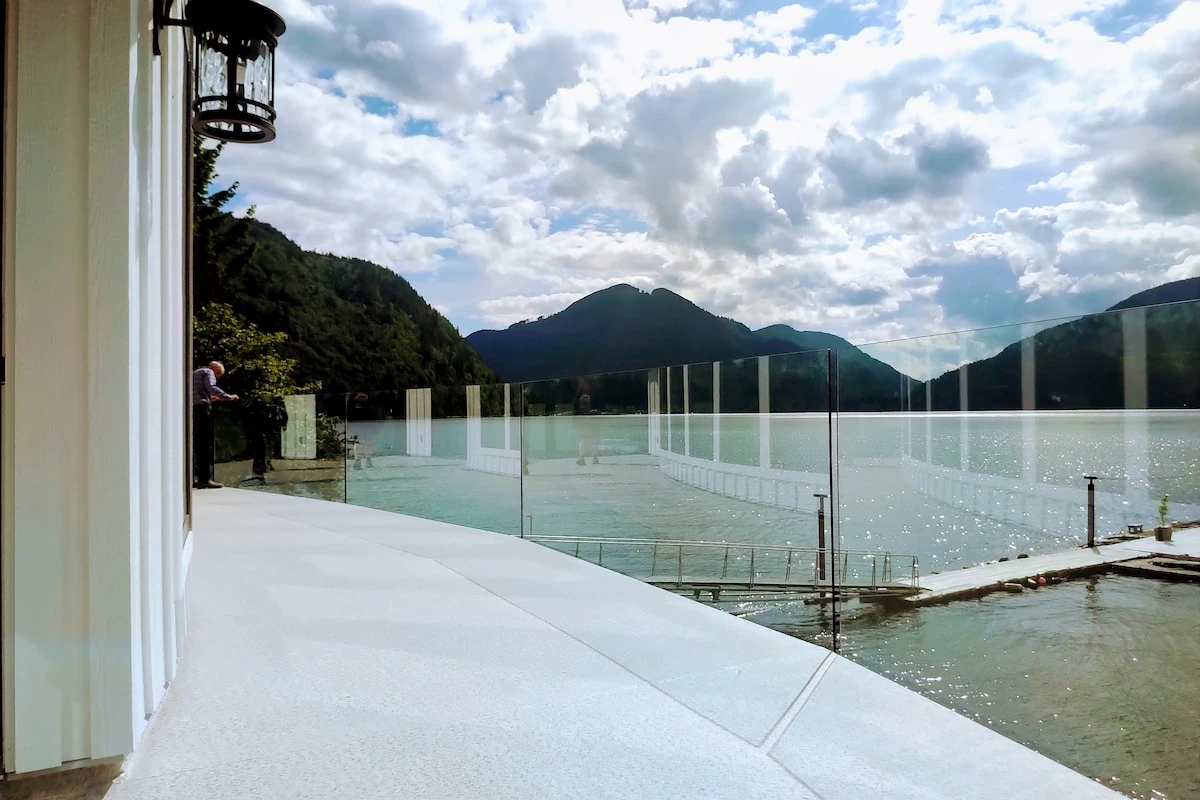
Frameless glass railings maximize view preservation with no posts interrupting sightlines. Glass panels mount directly to base shoes, standoffs, or spigots, each mounting option creates a different look, which can affect both appearance and drainage on rainy West Coast decks.
Best for:
Waterfront and mountain-view properties
Modern architectural styles
Maximum transparency requirements
Semi-Frameless Systems
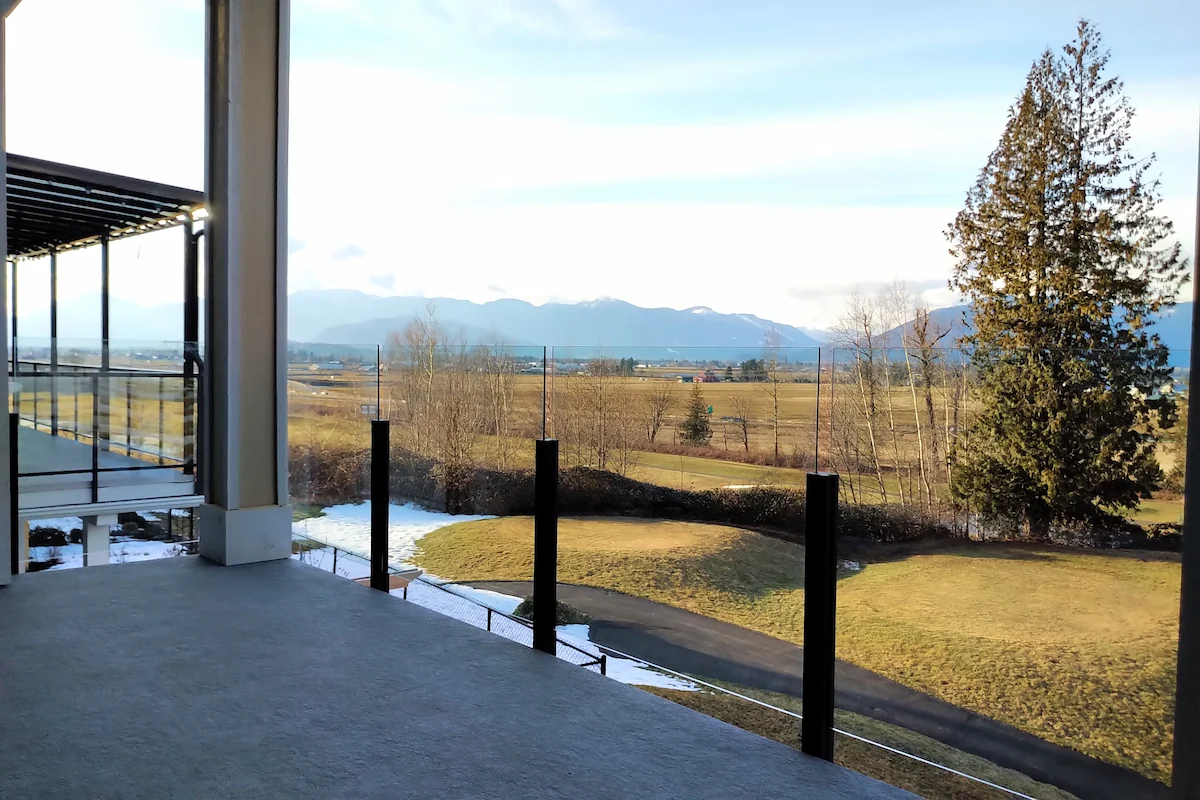
Semi-frameless railings balance view preservation with structural support. Aluminum posts at maximum 42-inch spacing hold glass panels.
Best for:
Budget-conscious projects
Properties where some framing complements architecture
Situations requiring faster permitting
For a detailed comparison of all options, see our guide to types of glass railings.
Get an Expert Opinion
Not sure which system suits your property? Every project starts with an on-site visit to assess conditions, take precise measurements, and recommend the best approach for your specific situation.
Request a free consultation or call (604) 819-9896 to schedule your site visit.
Key Takeaways
Vancouver's 169 rainy days per year create conditions where wood railings rot and metal corrodes faster than anywhere else in Canada
Glass is completely non-porous, meaning rain, humidity, and salt air have zero degrading effect on the material itself
Metal corrodes 5-10x faster in coastal environments compared to inland locations, making standard railings a poor choice for waterfront BC properties
Wood railings last only 10-15 years in Vancouver's climate even with annual maintenance, while glass systems last 25-30+ years with minimal care
Total cost of ownership often favours glass despite higher upfront costs when factoring 25 years of maintenance, staining, and replacement cycles
Solid glass panels create windbreaks that extend comfortable outdoor use into shoulder seasons, a practical benefit beyond durability
Frequently Asked Questions
Do glass railings hold up in Vancouver's rain?
Yes. Glass is non-porous, so rain sheets off without any absorption. Unlike wood that absorbs moisture and begins rotting, glass remains structurally unchanged regardless of rainfall exposure. The 169 rainy days Vancouver experiences annually have no degrading effect on properly installed glass railings.
How long do glass railings last in coastal BC?
Expect 25 to 30 years or more with proper installation and minimal maintenance. Glass panels themselves can last indefinitely. Hardware longevity depends on material quality, with marine-grade aluminum and stainless steel providing maximum durability in salt-air environments.
Are glass railings safe for families with children?
Yes. The 12mm glass used in Tenmar railings meets BC Building Code safety requirements, and solid panels eliminate the gaps and climbable profiles found in traditional picket designs. This makes them a strong choice for families with young children.
Do glass railings require special maintenance in salt air?
Salt air exposure requires slightly more attention than inland locations. Monthly rinsing with fresh water removes salt deposits. Quarterly cleaning with mild soap maintains clarity. Annual hardware inspection catches any corrosion early. See our coastal BC maintenance guide for complete details.
Can glass railings handle Vancouver's wind?
Absolutely. Properly engineered glass railings meet BC Building Code requirements for wind loads. Beyond handling wind safely, solid glass panels provide a windbreak benefit that extends comfortable outdoor use compared to open picket or cable railings.
What is the cost difference between glass and wood railings?
Glass railings cost more upfront compared to wood materials. However, glass requires no annual maintenance, staining, or replacement cycles. Over 20 to 25 years, total cost of ownership often favours glass. See our glass railing costs guide for detailed information.
Final Thoughts
Vancouver's combination of rain, humidity, and salt air creates one of Canada's most demanding environments for outdoor building materials. Glass railings are engineered for exactly these conditions.
Where wood rots and metal corrodes, glass maintains its clarity and structural integrity decade after decade. The minimal maintenance requirements and extended lifespan make glass a practical choice despite higher initial costs.
For homeowners prioritizing view preservation, durability, and long-term value, glass railings deliver on all three.
Ready to Upgrade Your Outdoor Space?
Every Tenmar installation is carefully measured and overseen from start to finish. From initial consultation through final walkthrough, you work directly with the team responsible for your project.
Contact Tenmar for a free consultation on glass railings built for BC's climate.
We serve homeowners across Vancouver, the Fraser Valley, and coastal British Columbia with precision-fabricated glass railing systems designed for local conditions.
From initial measurement through final installation, every Tenmar project is completed within 6 to 8 weeks. Browse our gallery or request a quote to get started.