Educational
Modern Glass Stair Railing: How Staircase Type, Materials, and Code Shape the Design
Published:
Last updated:
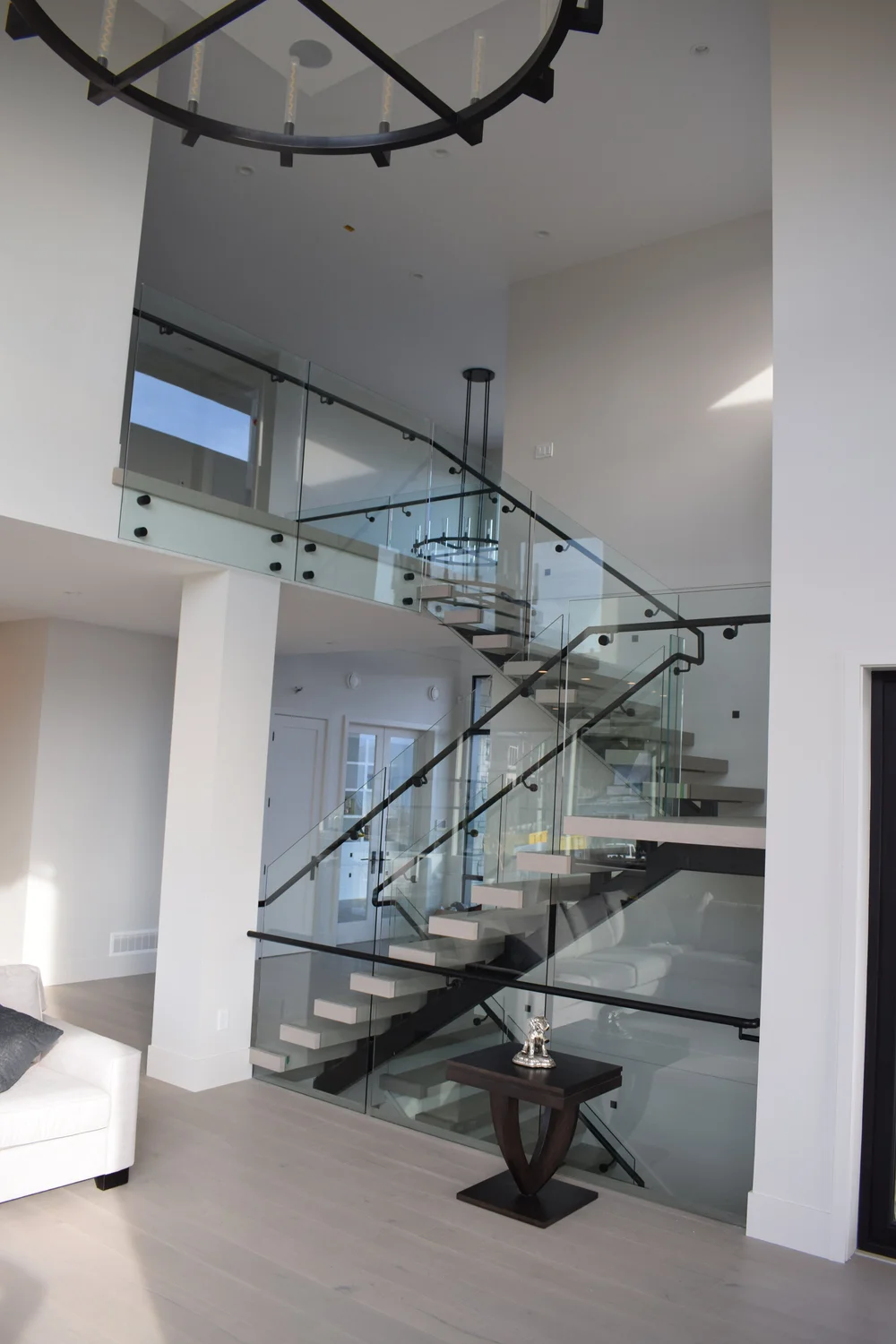
A modern glass stair railing does more than protect the open side of a staircase. It determines how much light reaches between floors, whether the staircase reads as a feature or a barrier, and how the surrounding rooms connect visually. The right glass system depends on the staircase itself: its shape, its stringer, the materials it is built from, and what the BC Building Code requires for handrails.
This guide covers how staircase architecture drives the glass design, which material pairings create which looks, how stringer type affects mounting, what glass stair railings do for interior space, the handrail graspability requirement unique to stairs, and what is involved in replacing existing balusters with glass.
For an overview of railing styles, mounting hardware, and glass types, see our guide to glass railing designs.
How Staircase Type Determines the Glass Design
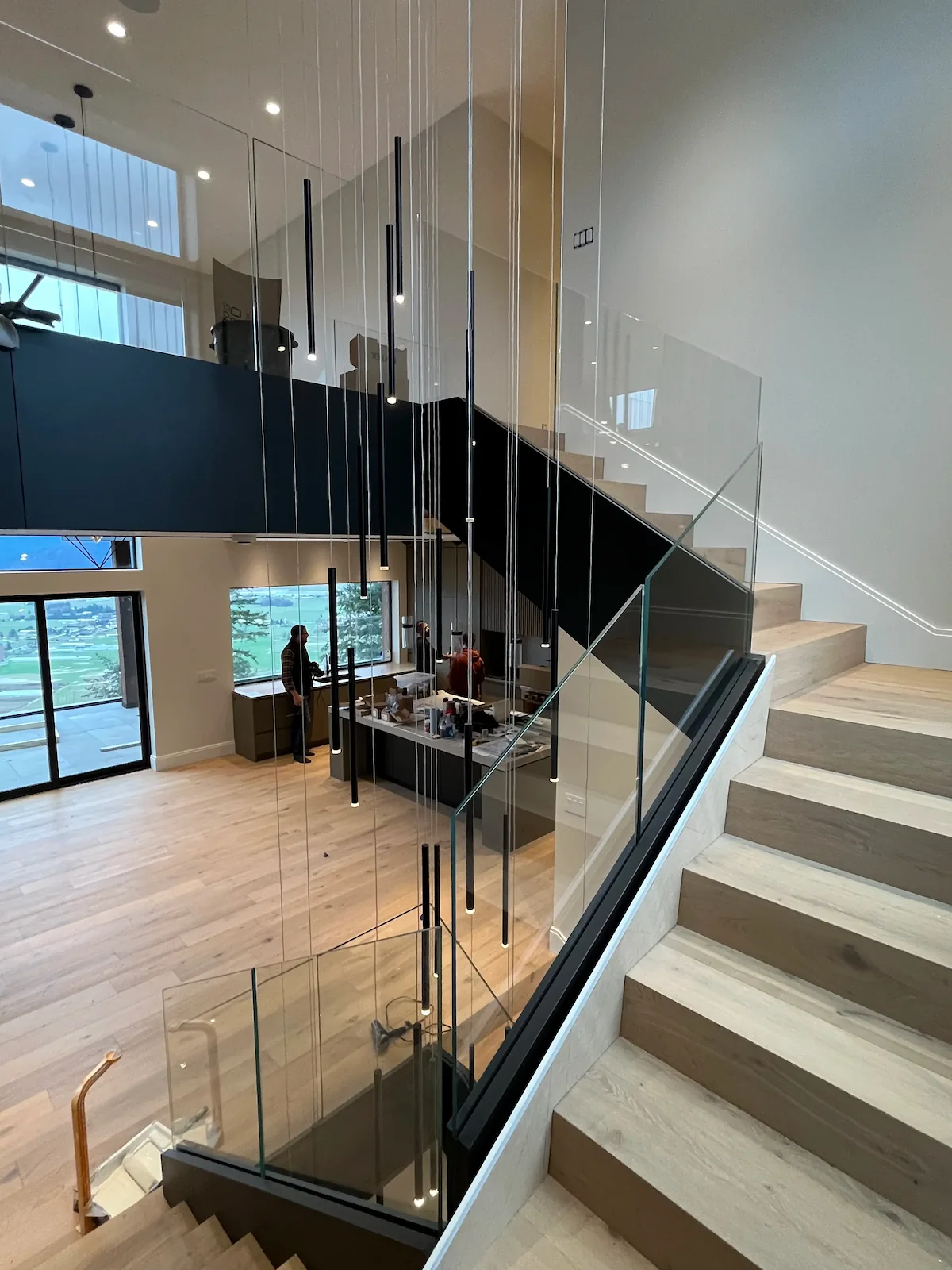
The shape and construction of the staircase dictates which glass systems are possible, how panels are cut, and where hardware can be mounted. A glass railing that works on a straight-run staircase may not be feasible on a spiral.
Straight-Run Staircases
A straight-run staircase travels in one direction from one floor to the next, sometimes with a mid-landing. This is the most common residential stair layout and the simplest for glass railing installation.
Glass panels are cut at the rake angle of the staircase (the angle of ascent). On a straight run, every panel follows the same angle, which means consistent panel dimensions and straightforward fabrication. Any mounting system works: base shoe channels that follow the stringer, standoffs attached to the stringer face, or spigots mounted to the tread edges.
Interior glass stair railings on straight runs are the most common residential application for glass.
L-Shaped and U-Turn Staircases
L-shaped stairs make a 90-degree turn at a landing. U-turn stairs reverse direction at a landing, creating two parallel flights. Both types require glass panels that transition between angled stair sections and level landing sections.
The transition point is where precision matters. Stair-flight panels are cut at the rake angle. Landing panels are cut level. Where they meet, the top edge of the glass must form a clean, continuous line. Misalignment at the transition is the most visible installation error on a multi-flight staircase.
Corner conditions on L-shaped stairs require either a corner post, a mitered glass joint, or an overlapping panel. Semi-frameless systems handle turns well because a post anchors each change of direction. Frameless systems require more precise engineering at corners but produce a cleaner result.
Floating Staircases
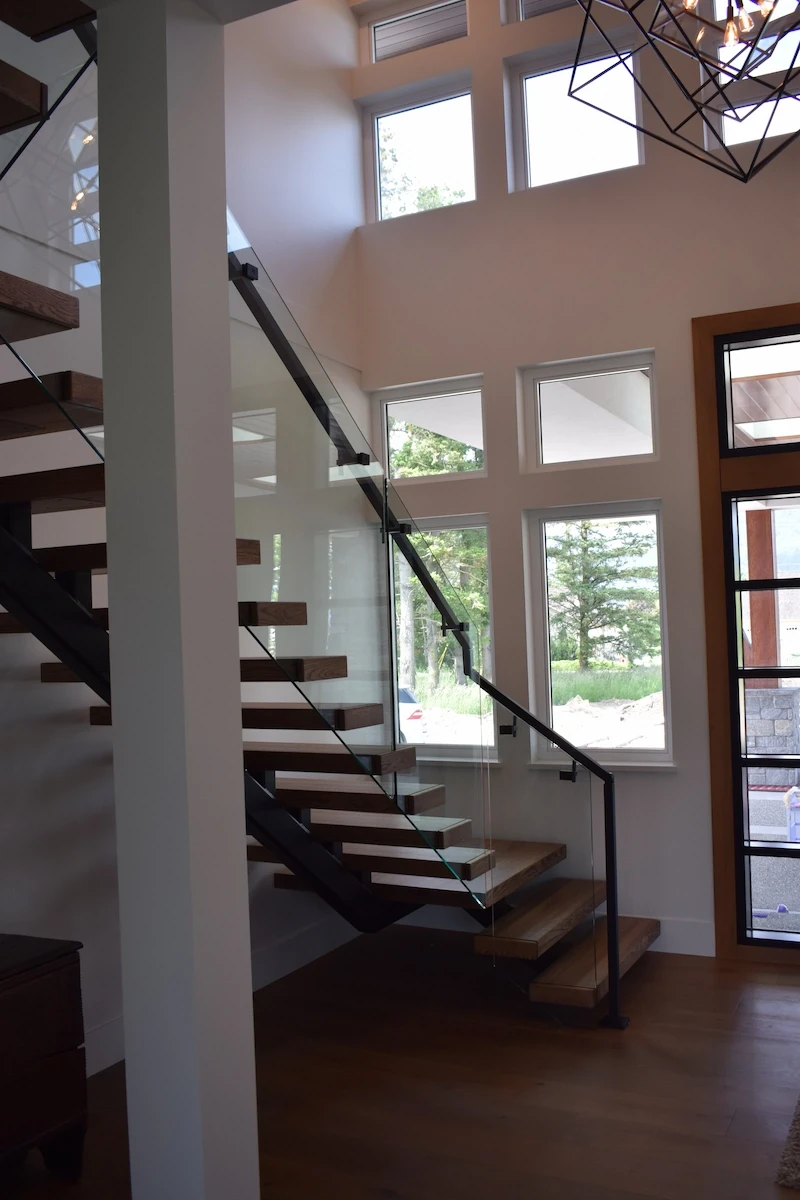
Floating staircases use open risers and cantilevered or mono-stringer construction to create the illusion that each tread is suspended in space. Glass railings are the natural companion for this design because opaque railings would hide the very engineering the staircase was built to showcase.
Mounting on floating stairs is different from conventional staircases. There is often no continuous stringer face to attach a base shoe channel. Instead, standoffs or spigots mount to the side of individual treads or to a concealed structural element beneath the tread.
The glass panels on a floating staircase must be precisely templated because the open-riser construction leaves no room to hide gaps or misalignment. Every edge is visible from every angle.
Spiral and Curved Staircases
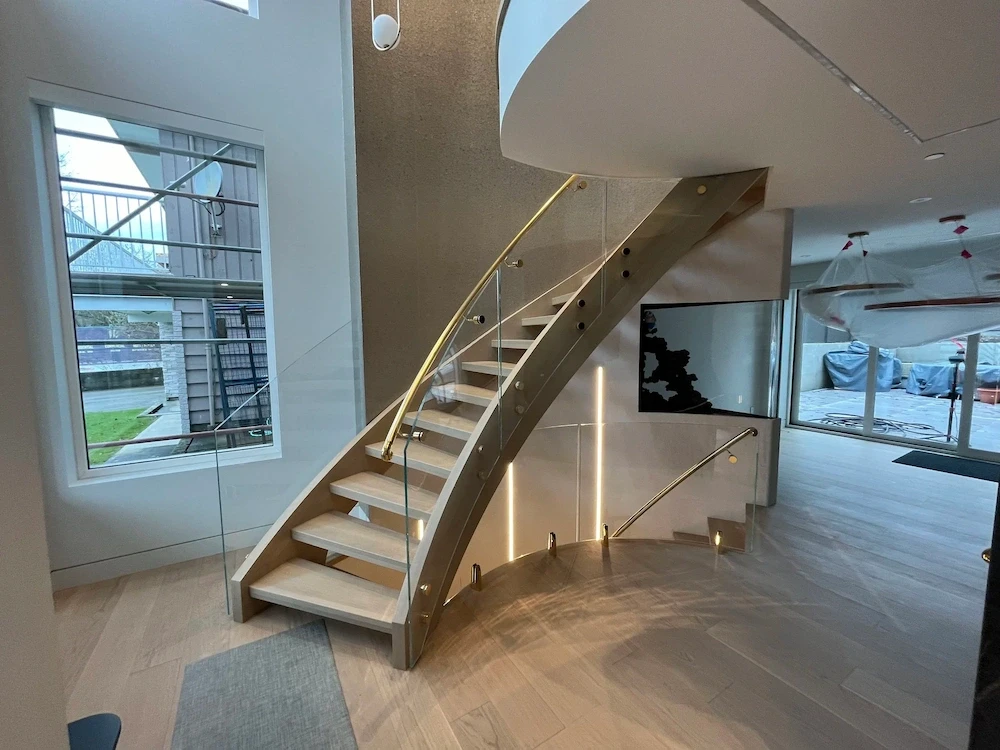
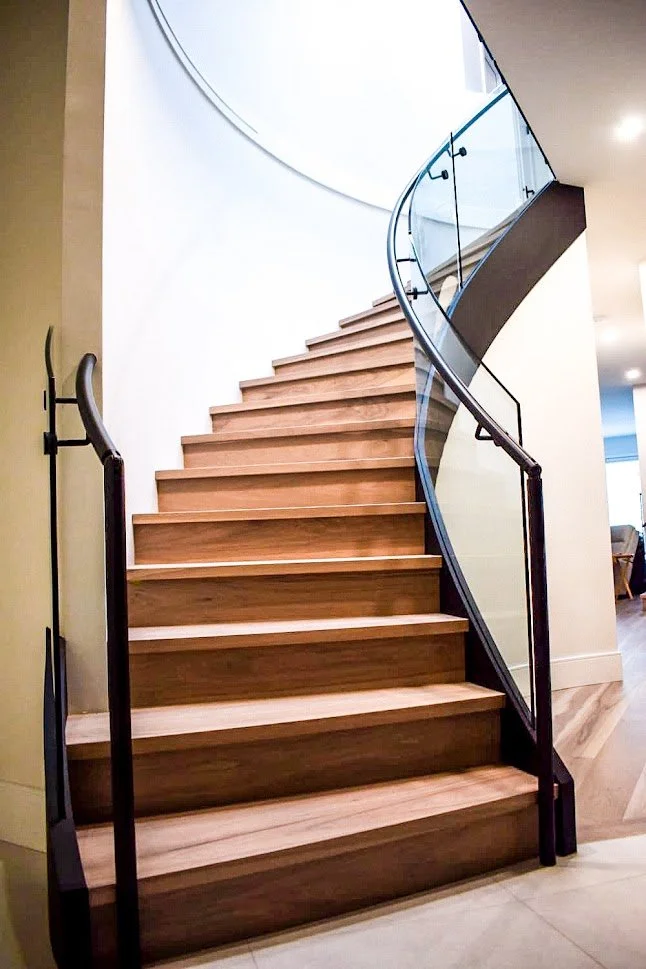
Spiral staircases follow a helical path around a central column. Curved staircases follow a sweeping arc without a central column. Both require curved glass stair railings with panels bent to match the radius.
Flat glass panels cannot follow a curved staircase. Each panel must be custom-bent to the exact radius, which requires precision templating on site and specialized fabrication. This makes curved glass stair railings a premium application with longer lead times and higher costs than straight-panel systems.
Curved glass railings on spiral staircases create a continuous, flowing line that flat-panel alternatives cannot replicate. The result is a staircase that functions as sculpture.
Exterior Staircases
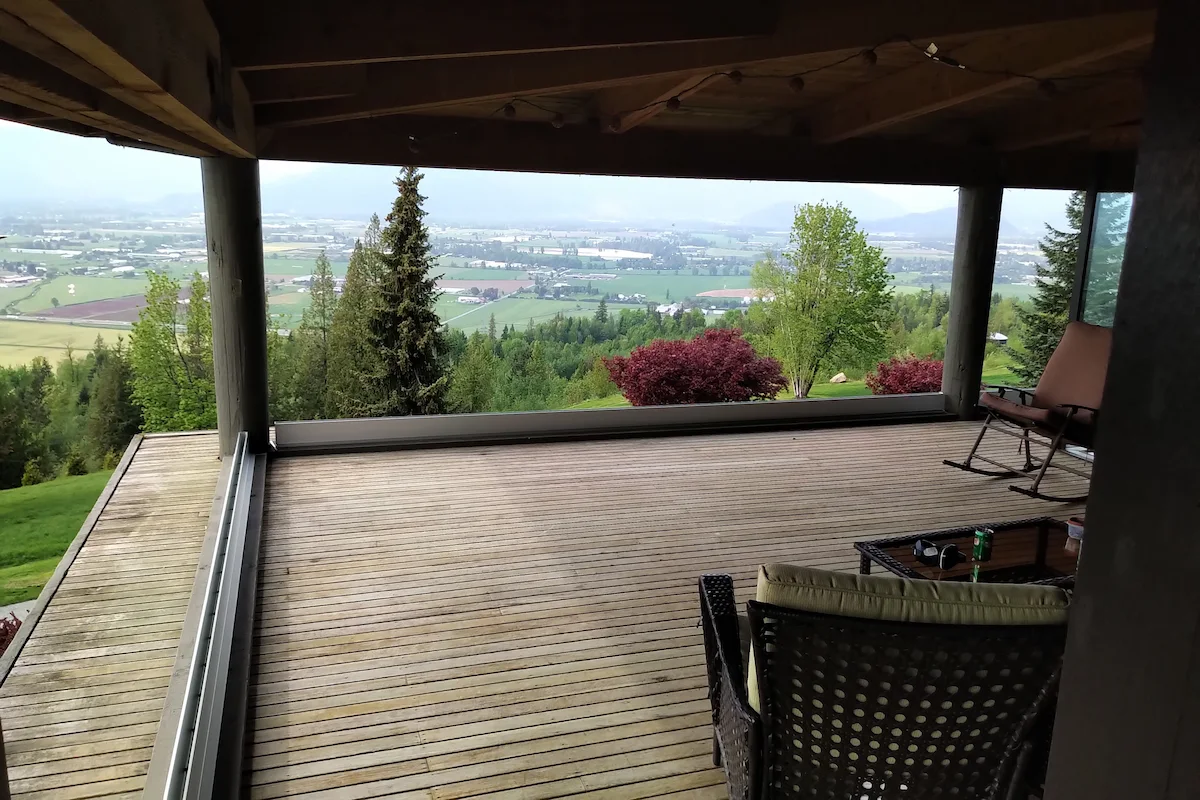
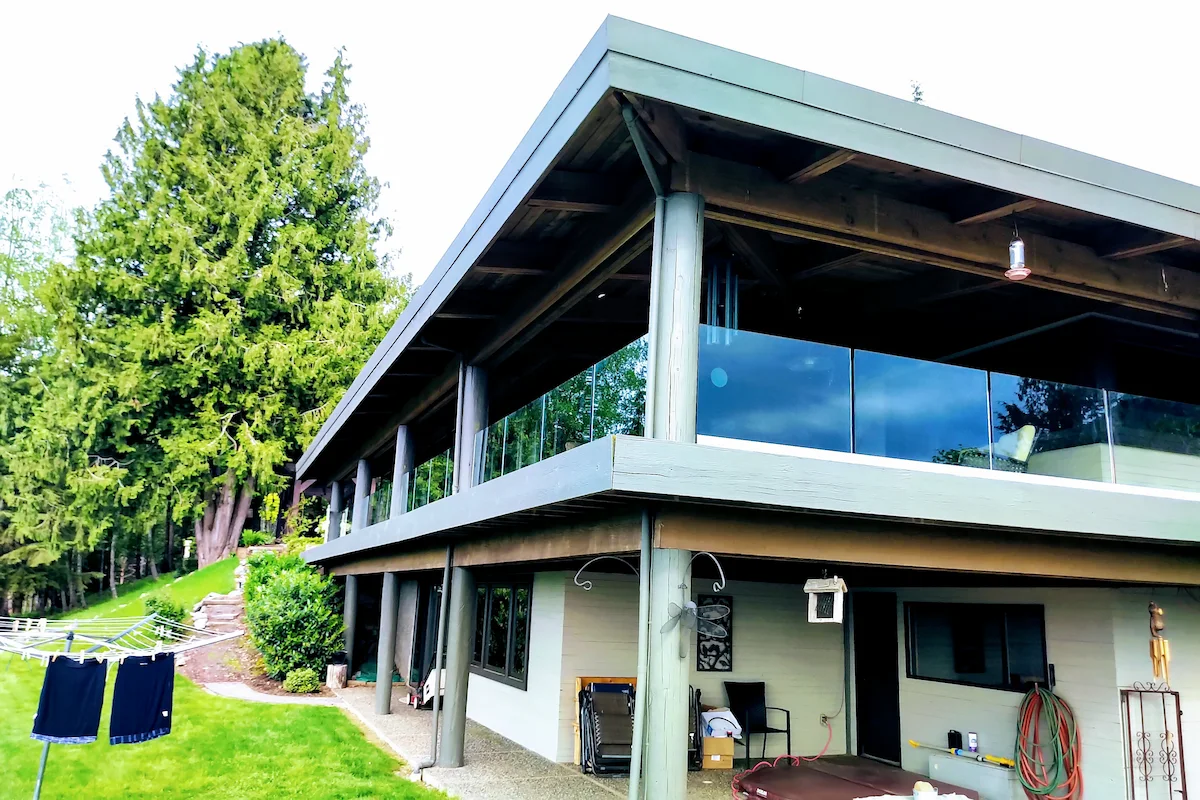
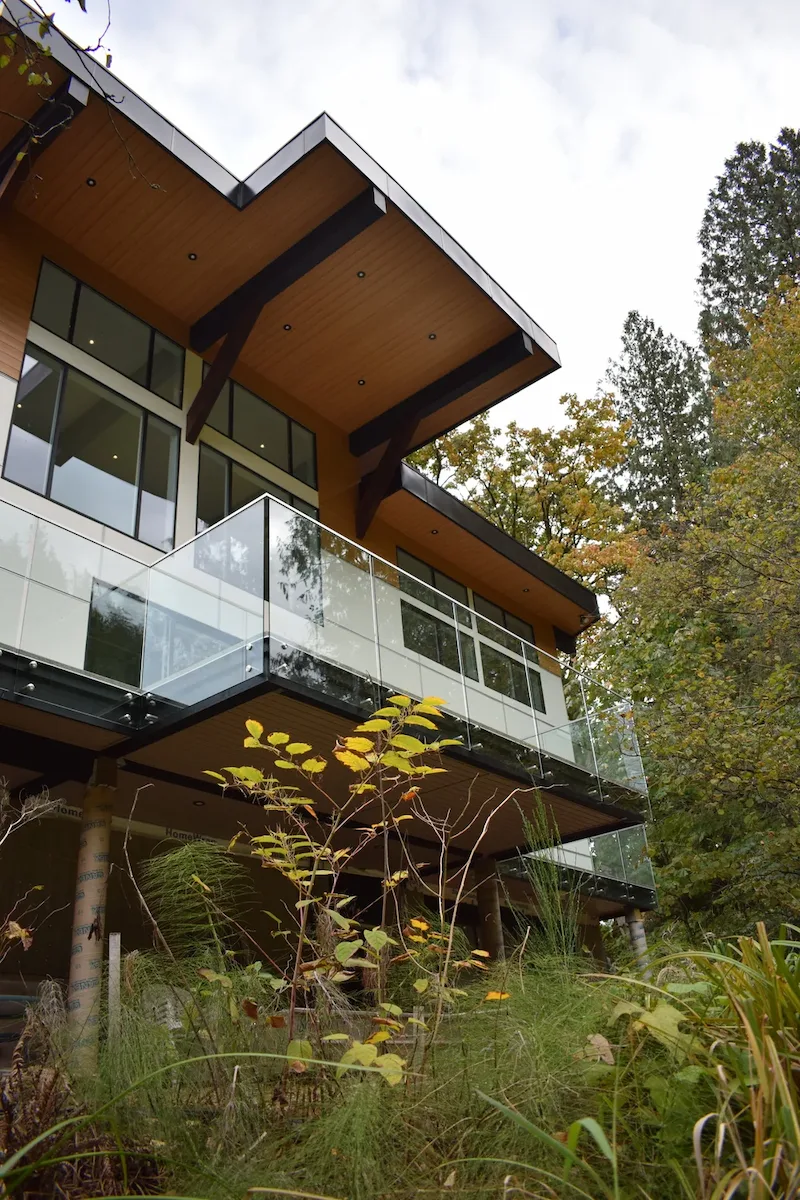
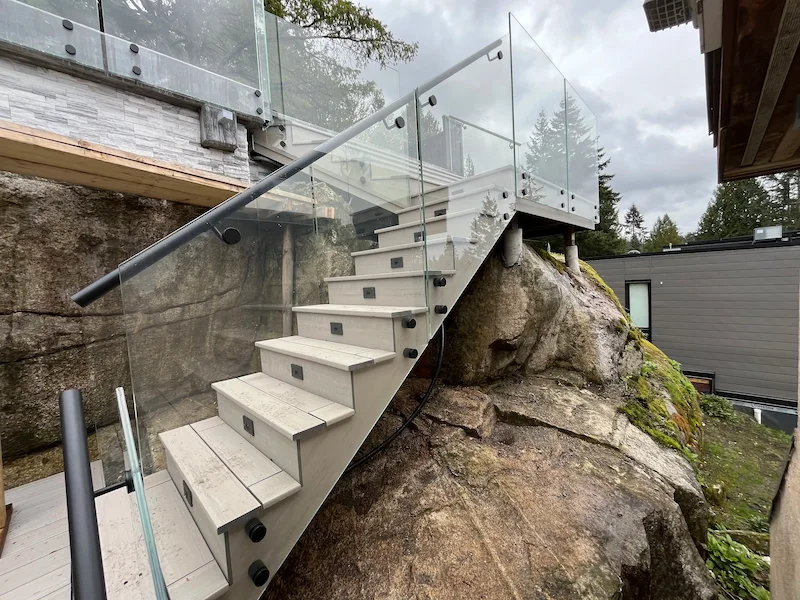
Outdoor stairs connecting upper decks, balconies, or rooftop terraces to lower levels face weather exposure that interior stairs do not. Exterior glass railings on staircases need corrosion-resistant hardware, and in coastal BC, marine-grade stainless steel or powder-coated aluminum hardware is recommended.
Drainage matters on exterior stair railings. Base shoe channels on outdoor stairs must include drainage slots to prevent water from pooling. Spigot systems avoid this issue entirely because water drains freely between the individual mounting points.
Glass stair railing installations across the Fraser Valley commonly serve both interior and exterior applications.
Material Pairings That Define the Staircase Look
Stair railings are not glass alone. The materials surrounding the glass, including treads, stringers, handrails, and hardware, shape the overall aesthetic. The same glass panel looks completely different depending on what it is paired with.
Wood and Glass
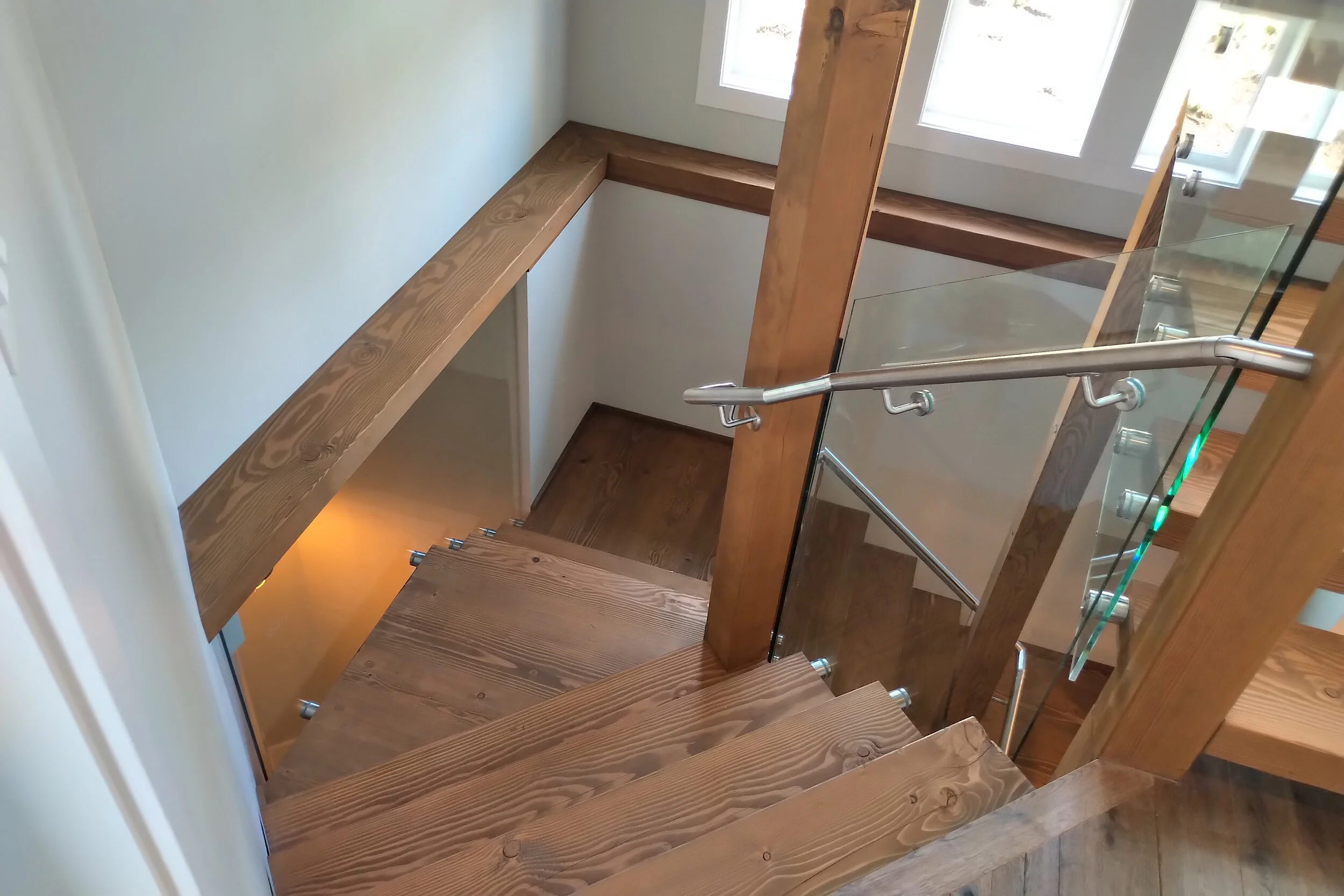
Wood treads with glass railings is the most popular combination in residential staircase design. The wood provides warmth and texture. The glass provides transparency and light. Together, they suit contemporary, transitional, and West Coast architectural styles.
Oak, walnut, and maple are common tread choices. A wood cap rail running along the top of the glass panels ties the railing back to the tread material, creating a cohesive line from floor to ceiling. Wood and glass staircases work especially well in homes where hardwood flooring continues onto the stair treads, making the railing the only transition element between floors.
Metal and Glass
Steel or aluminum stringers with glass panels create a more industrial or ultra-modern look. Matte black powder-coated steel is the most requested combination in current residential projects. It creates high contrast against clear glass and coordinates with black window frames, door hardware, and light fixtures common in contemporary homes.
Brushed stainless steel paired with glass suits coastal and minimalist interiors. The metal reads as neutral rather than decorative, letting the glass and the surrounding architecture carry the design.
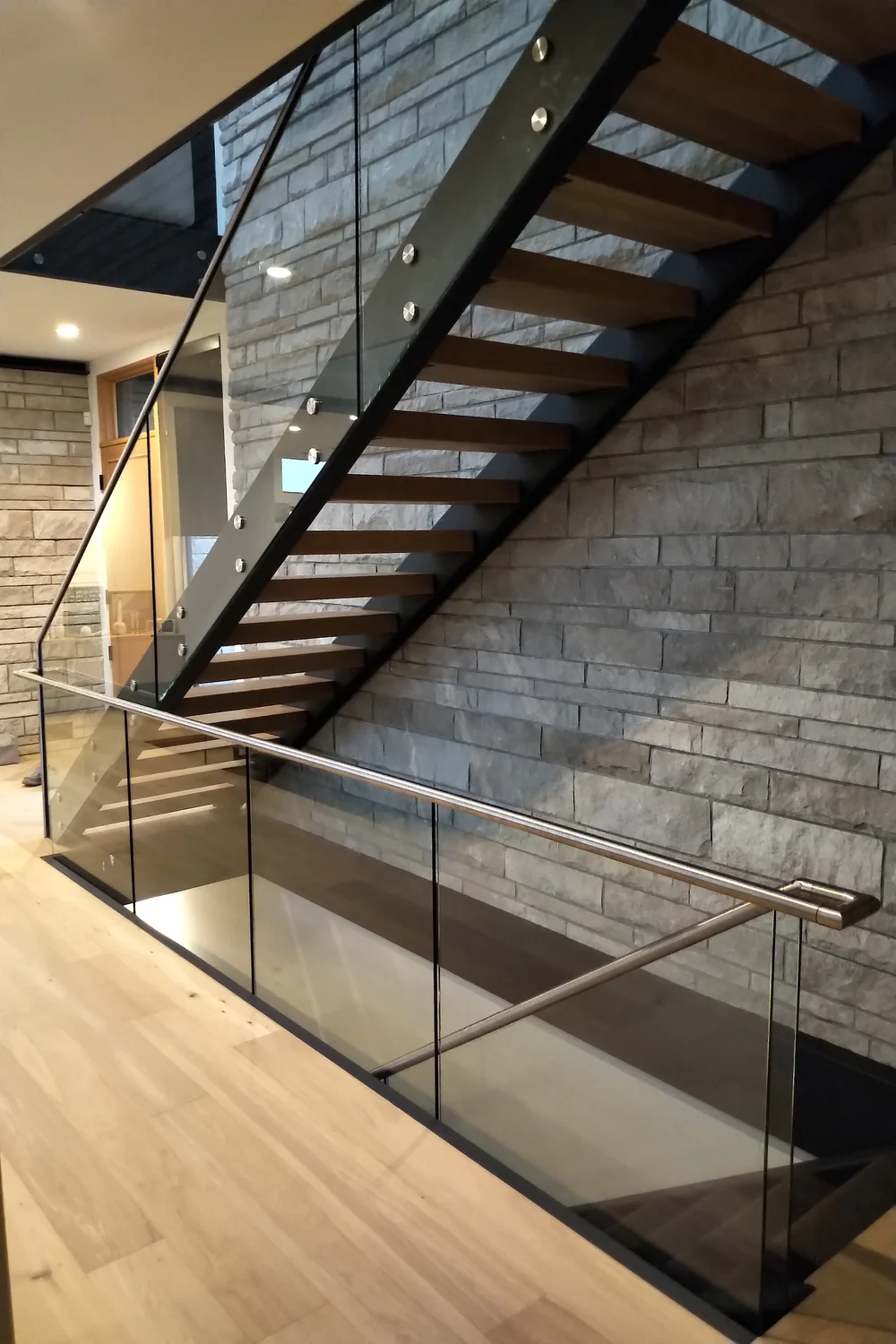
A metal mono-stringer with open risers and glass panels is the defining staircase of modern residential architecture. Each material, the steel structure, the wood or stone treads, and the glass railing, is visible and contributes to the composition.
Concrete and Glass
Concrete stairs with glass railings appear in modern custom homes, loft conversions, and industrial-style residences. The raw, heavy quality of concrete contrasts sharply with the transparency of glass.
Mounting glass to concrete requires mechanical anchors rather than wood screws. Spigot and base shoe systems are the standard choice for concrete stair applications because they bolt directly to the concrete surface. Standoffs can also work when mounted to a concrete stringer face.
Mixed Materials
Some of the most striking modern stair railings combine three or more materials. A concrete stringer with oak treads, glass panels, and a matte black metal handrail uses four materials in a single staircase. Each material serves a structural or functional role, and the glass keeps all of them visible.
The key to a successful mixed-material staircase is coordination. Hardware finishes on the glass mounting system should match or complement the metal elements elsewhere in the staircase and the surrounding room.
How the Stringer Affects Glass Mounting
The stringer is the structural backbone of the staircase, and its type and position determine where and how glass panels can be attached. This is a detail that general railing guides rarely cover, but it matters on stairs.
Mono-Stringer (Centre Beam)
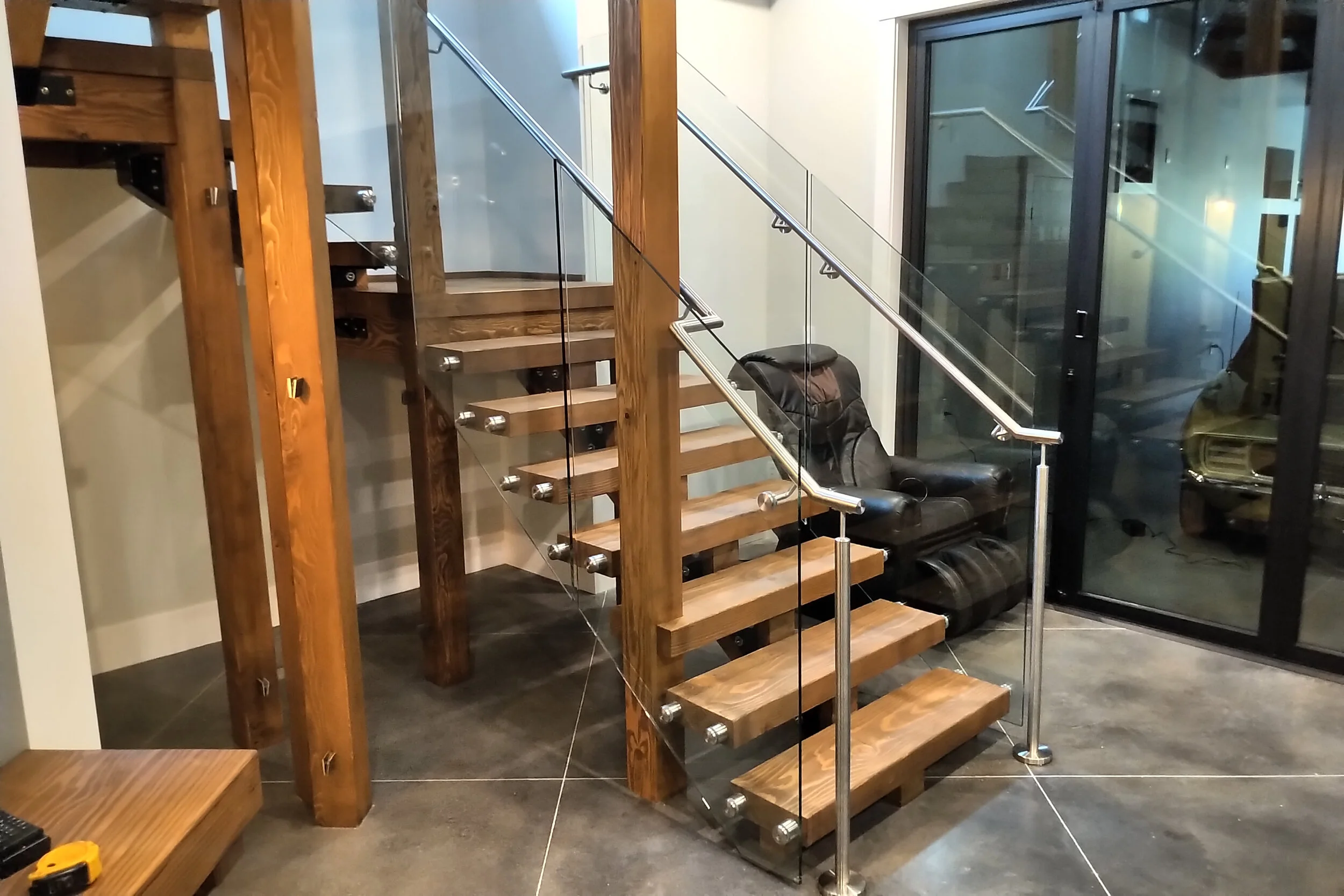
A mono-stringer is a single structural beam running down the center of the staircase. Treads cantilever outward from both sides. Glass panels mount to the outer edge of the treads or to a secondary structural rail because there is no stringer face on the open side.
Standoffs and spigots are the typical mounting systems for mono-stringer stairs. They attach to the tread edge or to a minimal support rail, keeping hardware compact and preserving the open feel of the design.
Closed Stringer (Side Walls)
A closed stringer runs along each side of the staircase, enclosing the tread ends. When one side is open (not against a wall), a glass railing mounts to the top of the stringer or the outer face.
Base shoe channels work well on closed stringers because the continuous stringer provides a flat, uninterrupted surface to anchor the channel. The glass rises directly from the stringer edge, creating a clean line that follows the angle of the stairs.
Open (Cut) Stringer
An open stringer follows the sawtooth profile of the treads and risers, exposing each step. Glass panels on an open stringer must be cut to follow this profile or be mounted above it with standoffs.
Open stringers with glass create a layered look: the sawtooth profile of the stringer is visible through the glass, adding visual depth. This combination suits traditional homes getting a modern update.
Wall-Mounted (No Stringer on Open Side)
Some staircases have treads embedded into a wall on one side with no stringer on the open side. The treads appear to float out of the wall. Glass panels in this configuration mount to the ends of individual treads using standoffs, spigots, or small brackets.
This is structurally similar to a floating staircase. Each mounting point must carry the load independently because there is no continuous stringer to distribute force along the railing run.
What Glass Stair Railings Do for Interior Space
Stair railings sit at the intersection of floors, rooms, and sightlines. The material choice has an outsized impact on how the interior feels.
Light Flow Between Floors
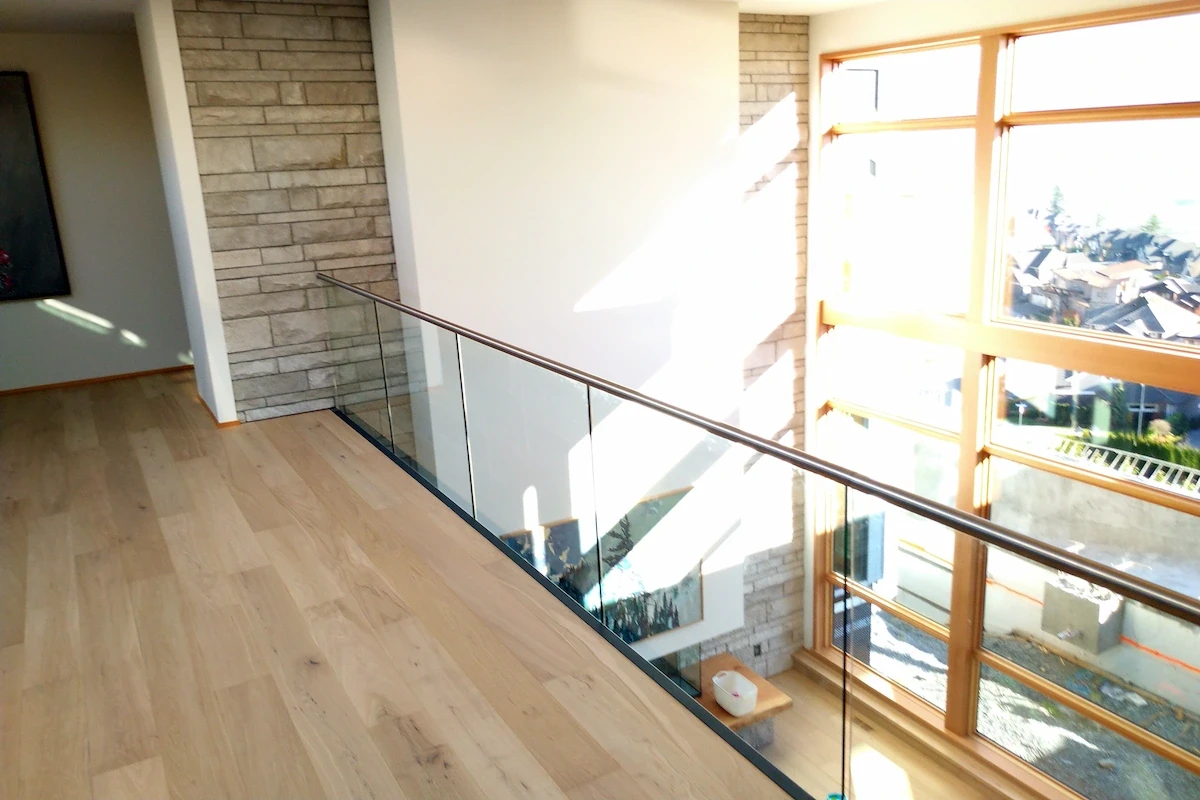
Wood balusters, metal pickets, and solid half-walls all block light from moving between floors. Glass panels allow natural light from upper-floor windows, skylights, and south-facing rooms to reach the main floor, the entry, and the hallway below.
A 2022 randomized control trial published in Building and Environment found that improvements to natural light in residential spaces produced approximately a 40% increase in perceived happiness among occupants (Morales-Bravo & Navarrete-Hernandez, 2022). While that study examined window and daylight design, the principle applies to any interior change that increases how much natural light reaches occupied rooms. Replacing an opaque stair railing or half-wall with glass is one of the most direct ways to improve light flow between floors without adding windows.
In homes with limited window area on the main floor, a glass stair railing can noticeably brighten adjacent rooms. The effect is most dramatic when replacing an existing solid railing or half-wall with glass.
Open-Concept Integration
Open-concept floor plans rely on uninterrupted sightlines between the kitchen, living area, and dining space. A staircase with opaque railings creates a visual barrier that divides the room, especially when the staircase sits in the centre of the main floor.
Glass railings let the eye travel past the staircase to the space beyond. The stair structure is still there, but it no longer functions as a wall. This is why glass has become the default railing material for open-concept renovations and new builds.
Making Narrow Stairwells Feel Larger
In townhouses, condos, and older homes, staircases are often narrow and enclosed. Glass railings reduce the visual weight of the stairwell. The transparency creates depth where solid materials create compression. For townhouse and condo staircases, this can transform the most constrained part of the floor plan.
Showcasing Architectural Staircases
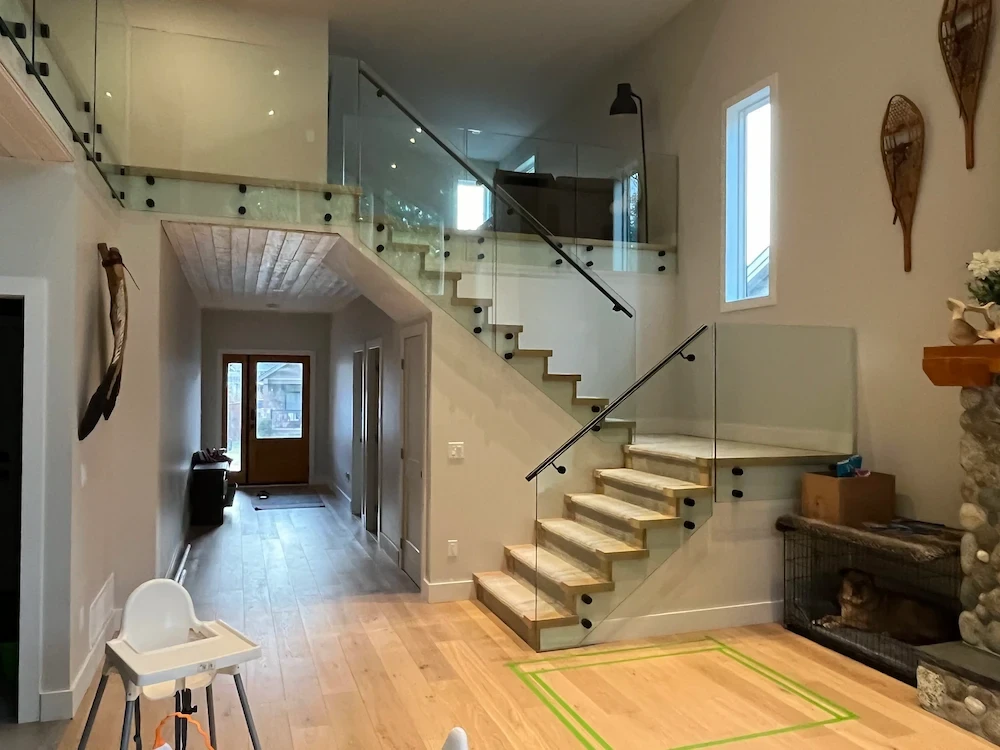
Modern staircases with floating treads, cantilevered steps, or sculptural stringers are designed to be seen. An opaque railing hides the engineering. A glass railing puts it on display. This is the reason glass railings and architectural staircases have become inseparable in custom home design. The job of the railing is to disappear so the staircase can be the feature.
The Handrail Question: What the Code Requires on Stairs
This is the most commonly misunderstood aspect of glass stair railings. A glass panel alone does not satisfy the BC Building Code handrail requirement. A separate graspable handrail is required on every staircase with three or more risers.
Why Glass Alone Is Not Enough
The BC Building Code 2024 requires a handrail that is "continuously graspable" along its length. A flat glass panel is not graspable. You cannot wrap your hand around it in the way you can grip a round or oval rail. This means every glass stair railing must include an additional handrail element.
This requirement is specific to stairs. On a balcony or deck, a glass guard without a top rail can meet code because there is no handrail requirement for level surfaces (only a guard height requirement). On stairs, both are required: a guard to prevent falls over the side, and a handrail to provide support while ascending or descending.
Handrail Options for Glass Stair Railings
Three approaches satisfy the code while maintaining a modern design:
Top-mounted cap rail. A wood, metal, or composite rail sits on top of the glass panels. This is the most common solution. The cap rail provides the graspable surface the code requires, and it adds a design accent that ties the railing to the tread material or the hardware palette of the room. A wood cap rail on glass creates warmth. A metal cap rail creates contrast.
Wall-mounted handrail. A separate rail attaches to the wall on the opposite side of the staircase from the glass. This keeps the glass side completely free of a top rail, which maximizes the frameless look. The trade-off is that the handrail is only on one side, which may not suit all users or wider staircases.
Glass-mounted handrail bracket. A handrail attaches directly to the glass surface using through-glass or surface-mounted brackets. This puts the graspable rail on the glass side without a full cap rail, preserving some of the frameless aesthetic while meeting code on stairs wider than 1,100 mm where two handrails are required.
Handrail Height on Stairs
The handrail must be between 865 mm and 965 mm (34 to 38 inches) above the stair nosing. If a cap rail also serves as the top of the guard, it must meet both the handrail height range and the guard height minimum (900 mm on stair flights within a dwelling unit). In most residential staircases, a cap rail at 900 mm satisfies both requirements simultaneously.
For a complete code breakdown, see our BC building code compliance page.
Replacing Existing Stair Balusters with Glass
Replacing wood pickets, wrought iron balusters, or metal spindles with glass panels is one of the most common residential renovation projects for glass stair railings. It is also one of the most impactful single changes a homeowner can make to an interior.
What Gets Removed
The existing balusters (vertical spindles between the handrail and the stringer or treads) are removed. In most cases, the existing handrail and newel posts are also removed to make way for the glass system. If the existing handrail is structurally sound and the homeowner wants to keep it, some glass systems can be adapted to fit beneath a retained top rail, but this limits design options.
What Stays
The staircase structure itself, the stringers, treads, and risers, typically remains. Glass railing replacement is a railing change, not a staircase rebuild. The existing stringer provides the mounting surface for the new glass system.
If the stringer is a closed type, a base shoe channel or standoffs can attach directly to it. If the stringer is open (cut), standoffs or spigots mount to the tread ends or the stringer profile.
Structural Considerations
Glass panels are heavier than wood balusters. A standard 12 mm glass panel for a stair section weighs considerably more than the wood or metal spindles it replaces. The stringer and its connections to the floor framing must be able to support this additional weight and the lateral loads the glass will transfer.
In most well-built residential staircases, the existing structure is adequate. In older homes with deteriorated stringers or inadequate connections, reinforcement may be needed before the glass can be installed.
The Visual Transformation
The before-and-after difference is dramatic. Wood pickets or iron balusters create a series of vertical lines that fragment the view and cast shadows across the stairwell. A glass panel replaces all of those lines with a single transparent surface. Light enters the stairwell. Adjacent rooms become visible. The staircase feels wider and the space feels larger.
This transformation is the reason glass stair railing replacement has become one of the highest-impact interior renovations for resale and daily enjoyment. The 2025 Remodeling Impact Report from the National Association of Realtors and the National Association of the Remodeling Industry found that interior finish upgrades, such as hardwood floor refinishing, recovered up to 147% of project costs at resale, the highest return among all interior renovations studied (NAR/NARI, 2025). Stair railing upgrades fall into the same category of interior material improvements that buyers notice immediately. The same report found that 46% of home buyers today are less willing to compromise on the condition of the home when purchasing.
Permits
A building permit is typically required for stair railing replacement in most BC municipalities. The permit ensures the new railing meets current code for guard height, handrail graspability, glass specifications, and opening limits. For custom stair railing projects, a site assessment before design ensures the new system fits the existing staircase structure.
BC Building Code Requirements for Glass Stair Railings
The BC Building Code 2024 sets requirements specific to staircase guards and handrails:
Guard requirement: Any staircase with a drop of more than 600 mm on the open side requires a guard.
Guard height on stair flights: Minimum 900 mm (36 inches) within a dwelling unit, measured vertically from the line connecting tread nosings to the top of the guard.
Guard height on landings: 900 mm where the drop is 1.8 m or less within a dwelling unit. 1,070 mm (42 inches) where the drop exceeds 1.8 m.
Handrail requirement: A graspable handrail is required on stairs with 3 or more risers (interior) or 4 or more risers (exterior).
Handrail height: 865 mm to 965 mm (34 to 38 inches) above the stair nosing.
Glass specification: safety glass, minimum 12 mm thick, conforming to CAN/CGSB-12.1.
Openings: No gap larger than 100 mm (4 inches) between panels or between the panel and the stair tread.
Anti-climbing: Guards must not have horizontal elements between 140 mm and 900 mm above the walking surface that could serve as footholds. Glass panels satisfy this requirement because they are a solid surface with no climbable elements.
Continuous handrail: The handrail must be continuous from the bottom riser to the top riser without interruption, except at newel posts where direction changes.
Glass stair railings are one of the few railing types that satisfy both the anti-climbing requirement and the opening-size limit inherently. A solid glass panel has no footholds and no gaps, which makes it a strong choice for families with young children compared to horizontal cable or bar railings.
Frequently Asked Questions
How is a glass stair railing different from a glass deck or balcony railing?
Stair railings involve angled panels cut to the rake of the staircase, transitions between stair flights and level landings, and a mandatory graspable handrail that balconies and decks do not require. The mounting also differs because stair railings attach to stringers and treads rather than deck edges or balcony slabs.
Does a glass stair railing need a handrail on top?
Yes. The BC Building Code requires a continuously graspable handrail on all staircases with 3 or more risers. A flat glass panel does not meet the graspability requirement. A top-mounted cap rail, wall-mounted handrail, or glass-mounted bracket must be included.
Can I keep my existing handrail and just replace the balusters with glass?
In some cases, yes. If the existing handrail is structurally sound and at the correct height, glass panels can be installed beneath it. However, this limits design options and may not produce the clean, modern look that a fully integrated glass system achieves.
How much does a glass stair railing cost in BC?
Frameless glass stair railings typically range from $300 to $400 per linear foot installed. Semi-frameless systems range from $250 to $350 per linear foot. Curved glass for spiral staircases costs more due to custom fabrication. See our guide to glass railing costs in Greater Vancouver.
Are glass stair railings safe for homes with children?
Yes. Glass stair railings use 12 mm safety-rated glass that meets BC Building Code load requirements. The solid panel has no horizontal bars, no climbable elements, and no openings larger than 100 mm. This makes glass one of the safest railing options for families with young children.
What type of staircase works with glass railings?
Any type. Straight-run, L-shaped, U-turn, floating, spiral, and exterior staircases all accept glass railing systems. The mounting method and panel fabrication differ by staircase type, but glass can be adapted to virtually any stair configuration.
How do I clean glass stair railings?
Clean panels with a non-abrasive glass cleaner and a soft cloth. Interior stair railings generally need cleaning every one to two weeks to remove fingerprints and dust. Panels along the handhold zone where people touch the glass while ascending will need attention most frequently. See our cleaning and maintenance guide.
Key Takeaways
Staircase type (straight-run, L-shaped, floating, spiral, exterior) determines which glass systems are possible and how panels are fabricated. Straight runs are simplest. Curved stairs require custom-bent panels.
Material pairings shape the look more than the glass itself. Wood and glass creates warmth. Metal and glass creates contrast. Concrete and glass creates drama. The glass stays the same; the surrounding materials change the character.
Stringer type (mono-stringer, closed, open, wall-mounted) dictates where mounting hardware can attach. This is a stair-specific constraint that deck and balcony railings do not face.
Glass stair railings improve interior light flow between floors, open up sightlines in open-concept homes, and make narrow stairwells feel larger.
A graspable handrail is required by code on all staircases. Glass panels alone do not meet this requirement. A cap rail, wall-mounted rail, or glass-mounted bracket must be included.
Replacing existing wood or metal balusters with glass is one of the highest-impact interior renovations. The staircase structure usually stays; only the railing changes.
Glass panels satisfy the anti-climbing and opening-size requirements inherently, making them a strong option for families with young children.
Ready to upgrade your staircase with a modern glass railing? Contact Tenmar for a free consultation. We design, fabricate, and install frameless and semi-frameless glass stair railings for homes across Vancouver and the Fraser Valley. See completed projects in our gallery.